

記事: A Gilded Legacy at the Edge of the Sound: Louis Comfort Tiffany and Southeastern Connecticut
A Gilded Legacy at the Edge of the Sound: Louis Comfort Tiffany and Southeastern Connecticut
When most people hear the name Tiffany, they picture the iconic blue box. But the story behind that name — and behind the art it represents — runs deeper and closer to home than most people realize. Louis Comfort Tiffany, son of the founder of Tiffany & Co. and one of America's greatest decorative artists, had profound and lasting ties to southeastern Connecticut. His legacy is still here, waiting to be seen.
A Connecticut Family
Louis Comfort Tiffany was born in New York City in 1848, but his roots were firmly planted in eastern Connecticut. His father, Charles Lewis Tiffany, grew up in Killingly, where the family operated a cotton mill — the same modest commercial enterprise that would eventually seed one of the world's most storied luxury brands.
Both Louis and his sister Annie found their first spouses in Norwich. Annie married Alfred Mitchell in 1871, and Louis wed Mary Woodbridge Goddard the following year. The Mitchells eventually acquired a grand estate overlooking the Thames River in New London — a property that today is the site of Mitchell College — and it became a second home for Louis and his family throughout the 1870s and 1880s. He painted Connecticut landscapes during these visits, sketched along the shoreline, and absorbed the particular quality of light that defines this stretch of the New England coast. Those visits were not a departure from his art. They were part of it.
Glass as a Medium, Light as a Language
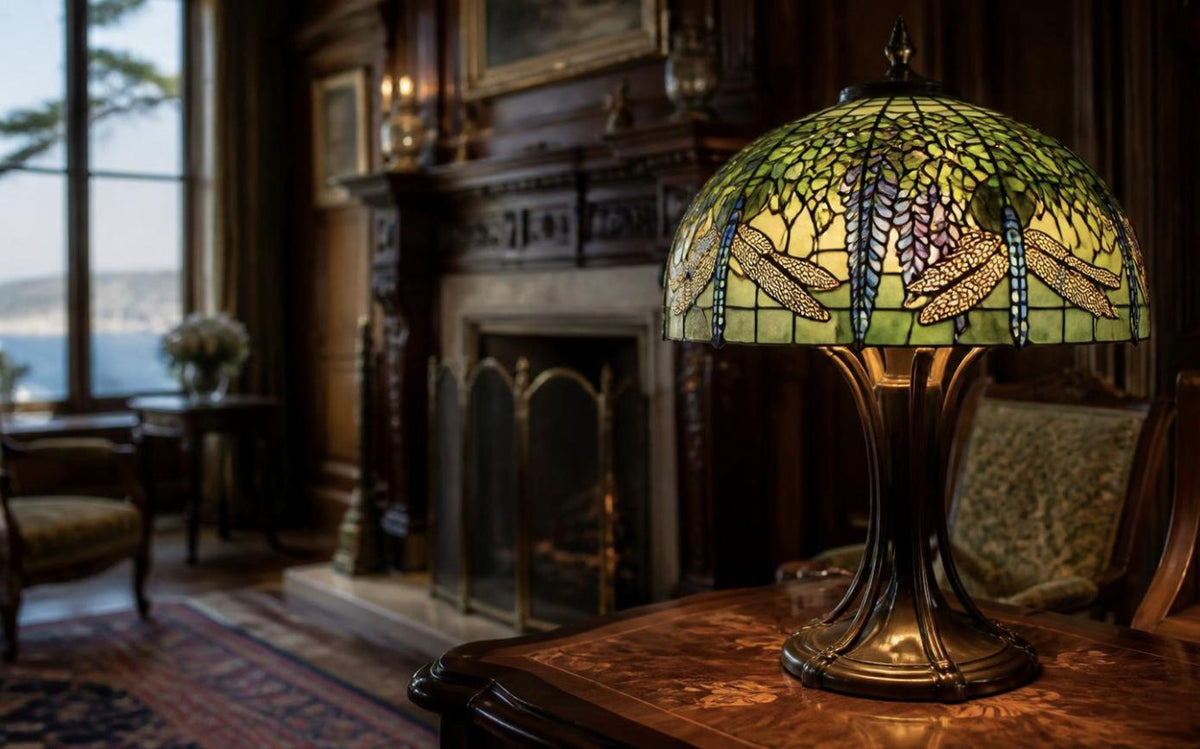
Louis Comfort Tiffany's genius lay in his understanding that light was not something that illuminated a work of art — it was the work of art. His favrile glass, blown and colored through an innovative process he developed in the 1890s, captured iridescence in a way no material had before. His stained glass windows transformed architectural spaces into environments of sustained, luminous beauty.
New London became one of the great repositories of that vision. Through the Mitchell family's deep connections in the local community, Tiffany received commissions from New London patrons throughout the late 19th and early 20th centuries. The results are still present in the city's churches and public spaces — memorials rendered in glass that have outlasted the people who commissioned them by more than a century.
Among the most remarkable surviving examples is Come Unto Me, a large-scale favrile glass window installed in 1924 at the All Souls Unitarian Universalist Church and later acquired by the Lyman Allyn Art Museum. Depicting Christ against a sweeping landscape of mountains, cypress, and still water, it represents Tiffany's mature style at its most assured — color and form working together with the quiet confidence of a lifetime's mastery.
The Other Tiffany Legacy: Silver
While Louis Comfort Tiffany was transforming what glass could do, the house his father built was doing something equally remarkable in silver. Tiffany & Co.'s silverware division, under the direction of gifted designers including Charles T. Grosjean, produced some of the finest American flatware and holloware ever made — objects that belonged in the same conversation as the greatest work coming out of England and Europe.
The Chrysanthemum pattern, introduced in 1878 and patented in 1880, stands as perhaps the most celebrated of all Tiffany silver designs. Grosjean drew on the era's fascination with Japanese aesthetics — itself ignited by the opening of Japanese trade and the revelatory Japanese exhibit at Philadelphia's 1876 Centennial Exposition — to create a pattern of extraordinary richness. Chrysanthemum blossoms and swelling foliage cover every surface in deep, sculptural relief, front and back, with the kind of all-over ornament that rewards close examination. It was Tiffany's most expensive flatware pattern at the time of its introduction, and for good reason: each piece contained up to three times more silver than comparable flatware from other makers. The pattern proved so enduring that after its initial discontinuation in 1934, public demand brought it back into production through 1955.
We currently have available a remarkable six-person Chrysanthemum sterling silver service with serving utensils — a complete, usable set in one of the most sought-after patterns in American silver history. Pieces like this are increasingly difficult to find intact, and they represent not just exceptional craftsmanship but a direct material connection to the Gilded Age world that Louis Comfort Tiffany himself inhabited.
Jewelry Across Two Movements
The Tiffany name has always moved fluidly between mediums, and the jewelry it produced reflects every shift in artistic sensibility with remarkable fidelity.

Art Nouveau Tiffany & Co. Brooch
The Art Nouveau brooch shown here captures the spirit of Louis Comfort Tiffany's glass at its most lyrical. Set in yellow gold, its open circular frame pulses with sinuous scrollwork — the signature whiplash line of Art Nouveau. At its center, translucent enamel grape leaves in soft greens hang above a pendant cluster of natural seed pearls in blush, ivory, and lavender. The palette could have been lifted from one of his Connecticut memorial windows: organic, luminous, alive. It functions as both brooch and pendant — a double life that feels entirely in keeping with the period's delight in transformation and craft. Both pieces have since found new homes, but they passed through our hands as vivid reminders of what this era produced at its finest.
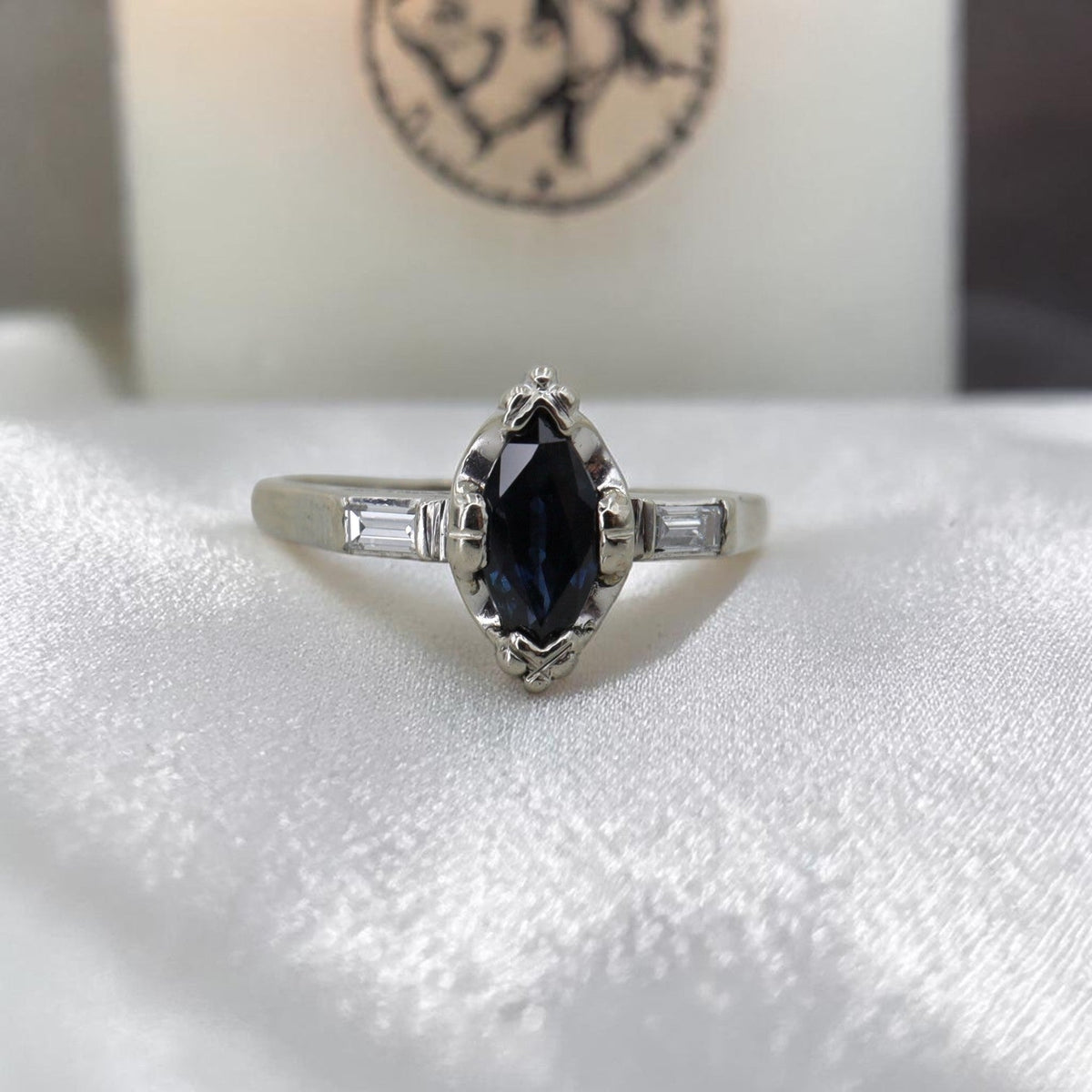
Then the world changed. By the 1920s, Art Nouveau's reverence for the organic had given way to Art Deco's appetite for geometry and contrast — and Tiffany & Co. made that transition with complete conviction. The Art Deco Tiffany & Co. Onyx and Diamond Ring represents the house at its most architecturally bold: a cushion-cut tablet of deep black onyx, polished to near-lacquer finish, centered by a bezel-set old European cut diamond of substantial size, its warm fire set against absolute darkness. Baguette diamonds continue down platinum shoulders with quiet precision. It is a masterwork of reduction — everything unnecessary stripped away, every element doing exactly what it must.
Two objects. Two movements. One philosophy.
Seen together — the Art Nouveau brooch and the Art Deco ring — these pieces trace the arc of an era. What connects them, across the decades and across the shift in aesthetic language, is the same thing that connects Louis Comfort Tiffany's stained glass to his father's silver: an absolute refusal to treat the decorative arts as anything less than art.
Visit the Lyman Allyn
The Lyman Allyn Art Museum's permanent gallery, Louis Comfort Tiffany in New London, brings together stained glass windows, lamps, favrile vessels, silver, jewelry, paintings, and archival photographs — many drawn directly from Tiffany family descendants. It is the first exhibition anywhere to focus specifically on the artist's Connecticut connections, and it makes a compelling case that some of the finest American art of the Gilded Age was made, at least in spirit, right here on the Thames.
The museum is located at 625 Williams Street in New London, just off I-95. It is well worth an afternoon.
The Tiffany name has always stood for something more than commerce. In New London, you can see exactly what that something is.
Dimitria Koumarnetos is the founder of Petra Star Fine Jewelry in downtown Mystic, Connecticut. With over three decades in the jewelry industry as a designer, buyer, and educator, she has a particular passion for estate and antique pieces and the histories they carry.

Dimitria Koumarnetosが執筆

コメントを書く
このサイトはhCaptchaによって保護されており、hCaptchaプライバシーポリシーおよび利用規約が適用されます。